A prosthetic finger that holds slippery objects more reliably, an ECG filter that preserves heartbeat timing, or a model that explains fluid resistance can become a focused biomedical engineering study. The strongest starting point is a health-related problem paired with something you can measure, change, and compare.
At Echelon Scholars, our individualized research mentorship helps students turn technical interests into original questions, rigorous experiments, and carefully developed manuscripts. Detailed feedback matters when a promising design behaves unexpectedly or an apparent improvement disappears under better testing.
The six studies below are illustrative starting points. Each needs a literature review to establish what is already known and refine a specific contribution. They cover biomechanics, biosignal processing, assistive technology, sensors, and biological transport without requiring patient recruitment. Biomedical engineering spans prosthetics, biosignals, neural interfaces, imaging and biomaterials; these biomedical engineering projects stay on the side of it you can reach from a classroom, where you apply engineering methods to a health question. Each is a low-cost study you can run with school equipment, and none needs a wearable device, a clinical dataset, or access to research institutions.
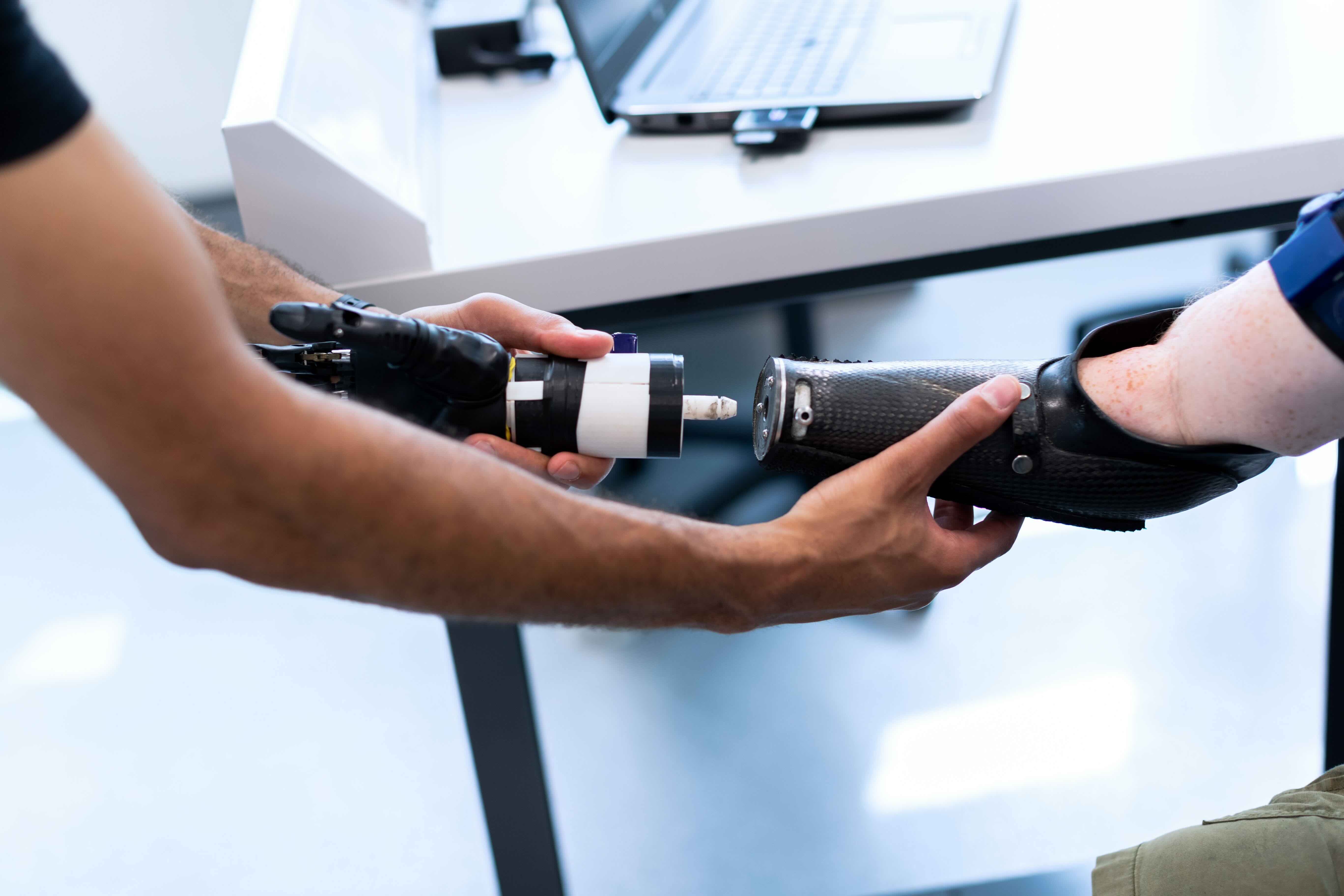
How does changing a tendon’s attachment position affect the tradeoff between closing force and fingertip travel? Build a tabletop articulated finger from cardboard, craft materials, or school-accessible printed parts. Pull its string tendon with a force gauge while keeping the joint geometry and starting position consistent.
Compare two attachment positions against the original design. Measure fingertip displacement and the input force needed to hold the same lightweight object, repeating trials across several object diameters. Use a teacher-supervised fixture rather than attaching the prototype to a person. Plot the force-versus-travel tradeoff and investigate where friction makes the measured result differ from a simple lever model. This turns a prosthetic-hand build into a test of a defined mechanical design choice, the question that sits behind prosthetics and robotics.
Which passive handle design reduces spoon-tip movement most effectively under the same imposed disturbance? Mount a spoon on a small, teacher-supervised mechanical test rig that produces repeatable side-to-side motion. Compare a rigid handle with two flexible, damped, or adaptive connections, using identical spoon geometry and loading.
Record video against a fixed scale to measure input and spoon-tip displacement. Sweep several disturbance frequencies and calculate the output-to-input amplitude ratio, keeping the input amplitude consistent. A connection may work well at one frequency and amplify motion at another. That frequency-dependent performance is a useful research result. Use small weights instead of food or human testers, and describe the outcome as bench performance of an assistive-device concept, not demonstrated benefit for people with tremor.
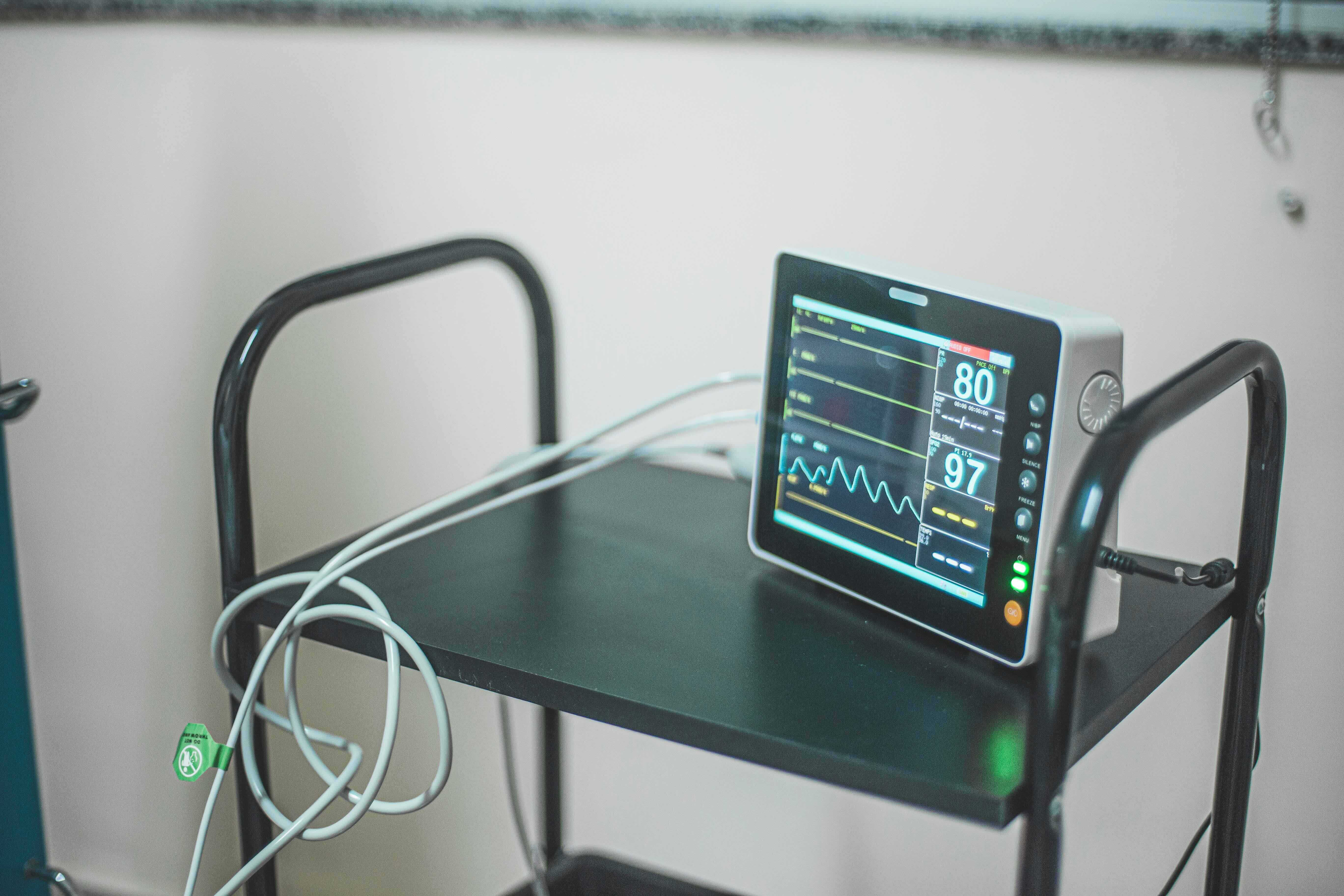
Which filtering approach best preserves heartbeat detection as electrode-motion noise increases? PhysioNet’s open MIT-BIH Noise Stress Test Database provides noisy ECG recordings at calibrated noise levels with reference beat annotations. This supports a computational project using Python, signal-processing tools, and a manageable selection of recordings on an ordinary laptop. The same question sits underneath patient monitoring, where a monitoring system has to find beats in real-time while the patient moves, and every physiological signal carries noise.
Compare an unfiltered baseline with two filtering methods while keeping the beat detector unchanged. Measure missed beats, false detections, and timing error at each noise level. Set parameters on designated development segments, then evaluate untouched segments, grouping related versions of the same underlying recording together. Analyze and report results by recording and noise level instead of treating every heartbeat as an independent patient. The central contribution could be identifying when smoother-looking signals actually produce worse measurements.
How sensitive is a modeled muscle’s leverage to small changes in joint position? OpenSim’s introductory musculoskeletal tutorial supplies models and tools for examining muscle-tendon lengths and moment arms. Begin by reproducing a tutorial result, then choose one muscle and a limited range of joint positions.
Choose a hamstring that crosses both the hip and knee so both joint positions have a clear anatomical role. Compare its moment-arm curve at a fixed hip angle with curves at nearby hip angles while sweeping the knee angle. Keep the model geometry unchanged so the comparison isolates joint configuration. Use OpenSim’s graphical plotting tools and a spreadsheet to calculate differences. A mentor can help identify a biomechanically meaningful range and interpret a two-joint muscle’s behavior. The extension should explain sensitivity or an overlooked interaction; repeating the tutorial alone is preparation, and a generic model does not predict an individual patient’s function.
How accurately does a simple flow model predict changes in resistance as a tube becomes narrower? Build a low-pressure, gravity-fed water setup with a reservoir, smooth tubing, a measuring container, and a timer. Poiseuille’s law provides a comparison for steady laminar flow through a straight circular tube.
Compare tubes of the same material and length but different measured internal radii, maintaining the same reservoir height above the outlet. Measure collected volume per unit time across repeated runs and compare it with the model’s radius-dependent prediction. Estimate measurement uncertainty, especially for radius and changing water level. Start with conditions compatible with laminar flow and investigate deviations systematically. Adult supervision should cover cutting and securing tubing. Water in a bench model represents selected flow mechanics, not the full behavior of pulsatile blood in elastic vessels.
How does uncertainty in membrane thickness affect predicted molecular transfer? Build a spreadsheet or small Python model using diffusion principles, with an explicitly assumed diffusion coefficient and fixed concentrations on either side. Compare a uniform-thickness membrane with one divided into equal-area patches of different thicknesses but the same average thickness.
Calculate total transfer rate by summing the patch contributions, which is how you integrate transfer across an uneven membrane, then vary the thickness distribution and assumed diffusion coefficient. Explain which assumptions drive the difference from the uniform baseline. This is a biological-transport modeling study with relevance to membrane-based medical devices, not a dosing model. A teacher or mentor should check units, boundary conditions, and whether the steady-state assumption suits the proposed question. The research extension lies in a justified sensitivity analysis beyond the standard textbook calculation.
Use our research process guide to move from a topic to a study plan. Write down the baseline, changed variable, outcome measure, and evidence that would challenge your prediction. Keep raw measurements, code versions, and failed trials so a reader can reconstruct your decisions.
These research topics are starting points, not finished questions. Originality can come from finding a failure condition, quantifying uncertainty, or explaining a design tradeoff. Building a working device establishes functionality; evaluating it against a meaningful alternative supports a research claim.
Our student Lukas Chung investigated signal-quality effects in ECG classification using PTB-XL. After several interventions failed to deliver the improvement he sought, he examined the training data more closely and developed class-specific findings. His paper was accepted to the IEEE International Conference on Bioinformatics and Biomedicine. Sustained technical iteration and detailed mentor feedback helped him develop the study and sharpen its claims.
For students seeking that technical depth, Echelon Scholars provides unlimited-hour, one-on-one guidance through engineering research and manuscript development, with continued mentorship and publication support at no additional tuition cost until acceptance by a peer-reviewed, postgraduate-level journal or conference. Explore our admissions process to discuss your interests and readiness for an independently executed, closely mentored project.
Yes. Public ECG data and musculoskeletal or transport models support computational studies. Mentorship can help you select a question that matches your laptop, quantitative preparation, and available data.
No. Mechanical bench studies can use spreadsheets and video measurements. Python becomes useful for signal processing or parameter sweeps, and technical guidance can help you learn the methods your question requires.
Only after the required review and approvals. For ISEF-affiliated research, human-participant rules require IRB preapproval for prototype testing by classmates, with consent and additional protections for minors. Start with bench testing while a qualified supervisor reviews any proposed human study.
A defensible engineering contribution beyond established work, supported by a clear comparison and reproducible evidence. A mentor can help you identify that contribution through literature review, then test whether your results actually support it.
About Echelon Scholars:
Echelon Scholars is a research mentorship program that pairs students with graduate-level mentors from Harvard, Stanford, and UC Berkeley. Our editorial team covers academic enrichment, research opportunities, and college preparation.