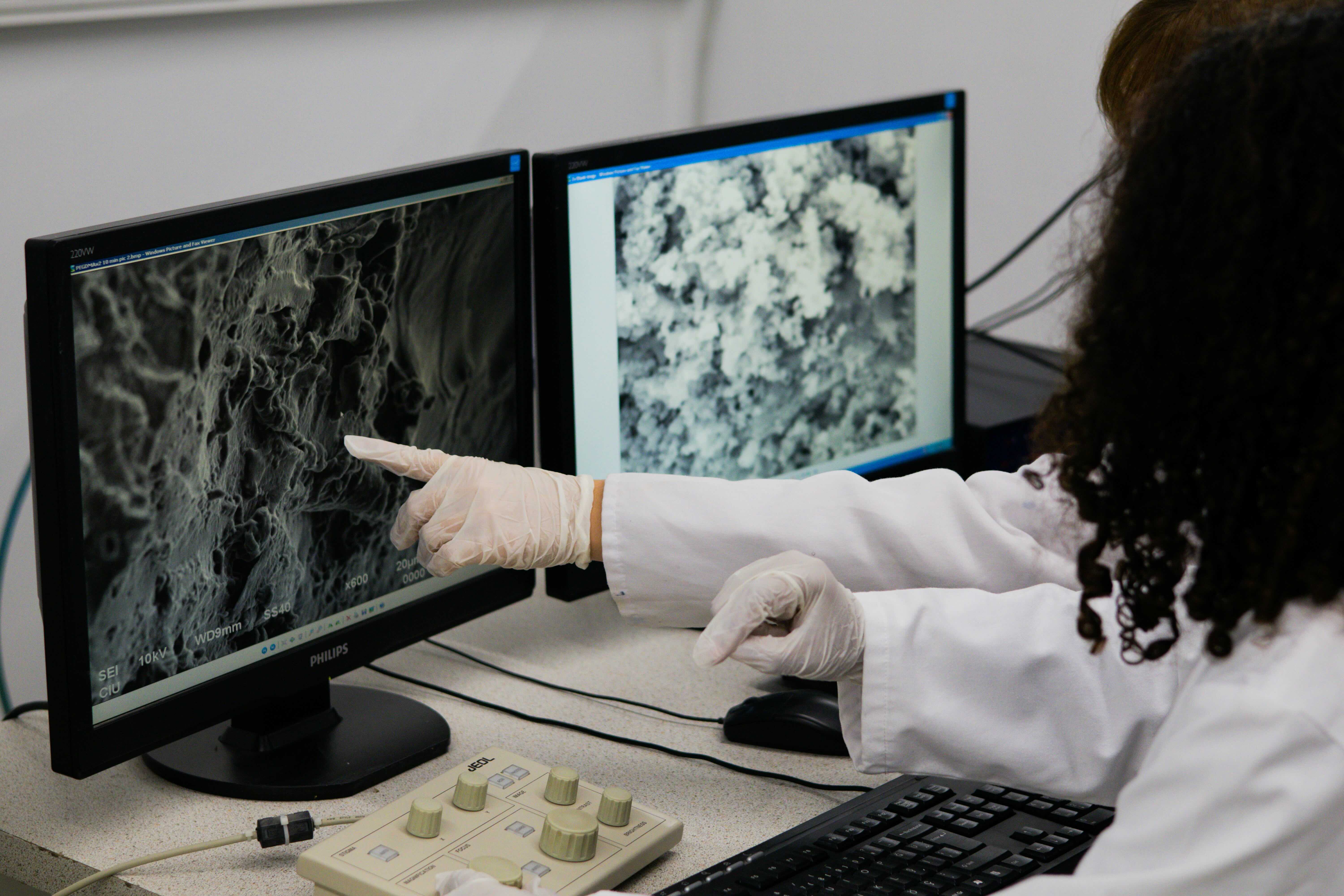
Six weeks in a university research environment can help you discover what scientific work actually feels like: learning a method, interpreting an unexpected result, and explaining your reasoning to other researchers. Boston University’s Research in Science & Engineering is a summer program for rising high school seniors, and it offers two distinct ways to build that experience.
The central choice is between an individual laboratory placement through the Internship and an instructor-led research experience through the Practicum. At Echelon Scholars, we help students turn scientific interests into focused investigations. That same habit is useful here: start with the kind of research work you want to learn, then choose the track that supports it.
The RISE Internship involves 40 hours of research each week for six weeks, guided by a faculty member, postdoctoral fellow, or graduate student mentor. Placements span science and engineering fields, including biomedical engineering, neuroscience, computer science, chemistry, and many others. Students develop technical and analytical skills and present their work at a final poster symposium.
This track suits a student who wants to experience a research group’s questions and methods in depth. You may be especially interested in how a particular laboratory investigates a problem, rather than in a broad introduction to an entire subject. Think about whether you enjoy working through a difficult procedure, keeping careful records, and improving an analysis after feedback.
The RISE Practicum combines instructor-led morning lectures with afternoon research and laboratory work. Students collaborate within a defined research structure and present at the same final poster symposium as interns.
The 2026 subjects were Computational Neurobiology and Data Science; the 2027 options will be announced in December. The neurobiology course combined neuroscience concepts with programming, computational modeling, and wet-lab experiments. Data Science emphasized statistical thinking, coding, uncertainty, and reproducible computing, with research formats such as time-series analysis, method benchmarking, and scientific software development.
A structured course can be particularly useful when you want a shared technical foundation before applying methods to a question. It still asks you to interpret results thoughtfully. Following a research protocol and understanding why it works are separate skills, and the second is what makes the experience intellectually valuable.
Write two short descriptions of an appealing summer research day. In the first, imagine contributing to a laboratory’s investigation and discussing your progress with a mentor. In the second, imagine learning a method alongside classmates and testing it in an afternoon project. Which setting would help you ask better questions and stay engaged when the work becomes difficult?
For illustration, a junior interested in the brain might want to study how a specific lab measures neural activity, or might first want to understand how a computational model represents a neural system. Those interests point toward different learning environments.
Summer 2027 applicants must be entering their senior year of high school in fall 2027 and be U.S. citizens or legal permanent residents. Their eligibility guidance excludes international students. You can live on campus as a residential student or commute from a relative’s home.
Use your junior-year preparation to identify an honest starting point. Strong science coursework, an experiment you can explain, or a coding project you have revised can give you concrete material for your application. Describe what you learned and how you responded to a challenge, rather than relying on a list of technical terms.
Applications open December 17, 2026. The 2027 timeline sets the deadline at 11:59 p.m. Eastern on February 3, 2027, including recommendations and all supplemental materials.
The instructions outline these materials:
You must submit your own application. Your recommender completes a form sent by email, not an independently uploaded letter. Materials list are subject to change for summer 2027, so use it for preparation but follow the final portal requirements.
Internship admission also involves faculty matching. Advancing to that stage is not an official offer: a faculty member must agree to host you. BU may consider researchers beyond your three choices and asks applicants not to contact faculty outside its standard process.

Summer 2027 rates will be posted on December 17. For a budgeting reference, the 2026 RISE charges were $6,415 for commuters and $10,735 for residential students. The residential total included tuition, housing, dining, and fees. The separate $75 application fee and personal spending were excluded.
Limited need-based aid is available. Upload the aid request and supporting documents by the same deadline. Admission decisions are made without considering financial need. For your family’s budget, separate the total charge from travel and personal expenses before deciding what contribution is realistic.
Choose one piece of work you know well and make a one-page research note. State the question, the method, one result, and a change you would make next. If the work was collaborative, identify your contribution precisely. This exercise gives you a clearer basis for each essay and for conversations with a future mentor.
A student with a small forecasting project, for instance, might explain why testing on later observations is more informative than randomly mixing past and future records. They could describe a simple baseline, compare its errors with a more complex model, and identify when the model performs poorly. The useful evidence is the reasoning behind the choices.
For faculty interests, read a laboratory’s research overview and one accessible paper. Write down the question the group studies, one method it uses, and the connection to your own interests. Our research topic guide can help you narrow a broad subject into a question you can discuss concretely.
If you want to develop a substantial original project with sustained individual support, Echelon Scholars’ research mentorship provides unlimited-hour, one-on-one guidance through topic development, technical iteration, manuscript preparation, and publication support. Detailed feedback and accountability help you understand and improve your own work. You can explore Echelon Scholars admissions to discuss your interests and preparation.
Yes. Boston University offers the program through Summer Term, alongside its other programs for high school students.
No. The Practicum uses instructor-led lectures and structured group research. The Internship places students in university research with a faculty, postdoctoral, or graduate-student mentor.
No. Summer 2027 RISE participants must be U.S. citizens or legal permanent residents entering senior year in fall 2027.
No. You receive an Internship admission offer only when a faculty member agrees to host you. Matching is a separate step after initial review.
You learn about your mentor and their research before accepting a placement. The specific project is introduced when you meet your mentor during the first week.
About Echelon Scholars:
Echelon Scholars is a research mentorship program that pairs students with graduate-level mentors from Harvard, Stanford, and UC Berkeley. Our editorial team covers academic enrichment, research opportunities, and college preparation.